


The selection of a washbasin is often underestimated during bathroom planning. Many focus on tiles, furniture, or fittings, while the washbasin itself is viewed merely as a functional component. In reality, this element has a decisive impact on the overall spatial impression, user comfort, and long-term satisfaction in everyday use.
In modern bathrooms, two options stand out in particular: the classic built-in washbasin and the significantly more contemporary countertop washbasin. While both solutions serve their purpose, they differ fundamentally in design, functionality, and overall impact.
While built-in washbasins were long considered the standard, countertop washbasins have increasingly established themselves in recent years as the preferred choice in high-end bathroom design. They combine aesthetics, individuality, and modern architectural expression in a way that traditional systems often cannot achieve.
What is a countertop washbasin?
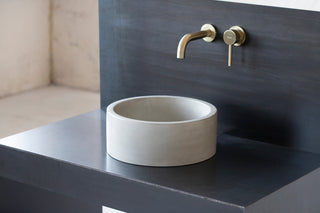
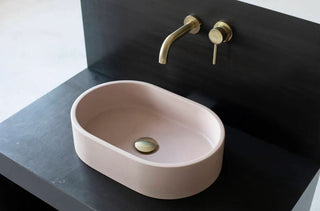
A countertop washbasin is a modern solution in which the basin sits entirely on top of a vanity unit or countertop. Rather than being recessed into the surface, it is intentionally presented as a standalone design feature. This creates a clearly visible, often sculptural appearance that significantly enhances the bathroom’s visual appeal.
One of its most striking characteristics is the wide variety of available designs. Countertop washbasins come in round, oval, rectangular, or organically shaped forms, allowing for a high degree of customization that integrates seamlessly into modern interior concepts. Premium materials such as high-quality ceramic, natural stone, or even glass further enhance the exclusive aesthetic.
Unlike traditional solutions, countertop washbasins prioritize not only functionality but also visual impact. They are not merely utilitarian fixtures, but deliberately integrated design elements within the space.
Why countertop washbasins are considered a modern premium solution
In contemporary interior design, individuality plays an increasingly important role. Bathrooms are no longer planned purely for functionality but are now perceived as living spaces with a strong emphasis on design. This is where countertop washbasins truly excel.
They create a clear separation between furniture and basin, resulting in a refined and architectural look. The vanity becomes a stage, and the basin becomes the focal point. This design flexibility is one of the key reasons why architects and interior designers increasingly favor this solution.
Another advantage is their compatibility with modern fixtures. Tall freestanding taps or wall-mounted fittings complement the design perfectly and further emphasize the premium character of the overall aesthetic.
What is a built-in washbasin?
The built-in washbasin is the classic solution in bathroom construction. It is integrated into a countertop, forming a functional unit with the furniture. The basin is partially or completely recessed into the surface, resulting in a clean, subtle, and understated appearance.
This design is primarily focused on functionality. It has proven itself over many years and is commonly used in standard bathrooms or heavily utilized households.
The emphasis is clearly on practicality and ease of cleaning, while design considerations tend to play a secondary role.
Design impact: The key difference
The greatest advantage of the countertop washbasin lies in its visual presence. It transforms the perception of the entire bathroom. Instead of being a purely functional element, it becomes a consciously designed focal point.
This effect is particularly important in modern bathrooms, where minimalism and high-quality materials dominate. In such environments, the countertop washbasin acts as a deliberate design object that introduces elegance and structure to the space.
In contrast, the built-in washbasin visually blends into the furniture. While it fulfills its function reliably, it remains in the background from a design perspective. In contemporary living concepts, this is increasingly seen as a drawback, as bathrooms are more and more regarded as design-oriented spaces.
Functionality in everyday use: A balanced perspective
Although the countertop washbasin clearly excels in terms of design, practical usability remains an important consideration. Here, modern materials have largely eliminated many of the disadvantages previously associated with this type.
High-quality ceramic surfaces are now highly durable and easy to maintain. While the visible edges may require slightly more cleaning effort, this is negligible in everyday use with regular care.
Built-in washbasins may offer marginally easier cleaning, but this advantage is minor compared to the significant loss in design quality and individuality.
Which washbasin is best for small bathrooms?
In smaller bathrooms, it is often assumed that only purely functional solutions are suitable. In practice, however, compact countertop washbasins can create a highly refined look without overwhelming the space.
Thanks to their clean shapes and the ability to combine them with slim furniture, they can make even small bathrooms feel modern and open.
Built-in washbasins, while unobtrusive, tend to lack character and visual impact in smaller spaces.
Why countertop washbasins are the better long-term choice
When choosing a washbasin, it is important to consider not only short-term functionality but also long-term impact on spatial quality and living experience.
Countertop washbasins offer clear advantages in this regard. They maintain a timeless modern appeal and adapt easily to evolving interior styles without losing their impact. Additionally, they are more flexible during renovations, as they function as independent design elements.
Built-in washbasins, on the other hand, are more closely tied to the furniture structure and can appear outdated more quickly as design trends evolve.
Conclusion
This comparison clearly shows that both solutions have their place, but they serve different priorities.
The built-in washbasin is a solid, functional, and time-tested solution for traditional bathroom concepts. It performs reliably, though it remains visually understated.
The countertop washbasin, by contrast, is the more modern and premium option. It offers greater design freedom, stronger visual impact, and aligns perfectly with contemporary bathroom concepts that emphasize aesthetics and individuality.
For those who view their bathroom not only as a functional space but as a designed living environment, a countertop washbasin is clearly the superior and more valuable long-term choice.